



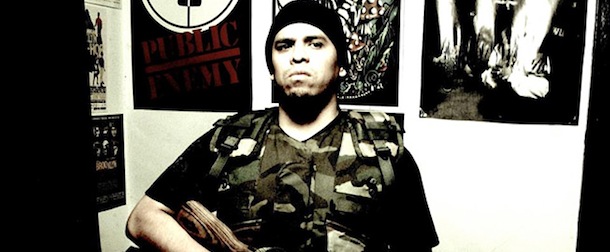
courtesy photo
interview by Kekeli Dawes | intro by Chance Solem-Pfeifer
Ask Immortal Technique about the conflict in Syria, and don’t be surprised if he starts with the Ottoman Empire and works forward.
The internationally acclaimed rapper speaks about war like an impassioned historian, about economic inequality like a poetic Marxist and about the state of corporatized hip-hop as one of its harshest DIY critics.
Felipe Coronel (aka Immortal Technique) has become a sounding board for social, racial and political controversies as much as the music he writes to illuminate and eviscerate them. In the wake of the George Zimmerman verdict, Immortal Technique engaged in a sustained conversation on race relations with his nearly quarter of a million Twitter followers. In 2008, he used the profits from a compilation album to travel to Kabul, Afghanistan, and build an orphanage from scratch, an undertaking he dubbed “The Green Light Project.”
The musical result of those convictions began in The Bronx — one of the most identifiable birthplaces of American hip-hop — where his family immigrated from Peru when he was an infant. After refining his craft during a year of prison time, Immortal Technique’s debut record was 2001’s aptly titled Revolutionary Vol. 1. He followed up with a pair of albums in the 2000s, Revolutionary Vol. 2 and The 3rd World. As of late August, he stated that his long-awaited album The Middle Passage is half-completed.
Immortal Technique will perform at The Waiting Room this Friday as a stop on his War & Peace tour with Brother Ali. Tickets are available here.
But first, dive into some of ideology behind the artist’s outspoken social justice convictions. Immortal Technique offered to answer three questions from our contributor Kekeli Dawes:
Hear Nebraska: You do a great deal of work outside of the booth. You’ve done work from Afghanistan to the United States to Haiti. Even if you may not have a mic in hand, is that still hip-hop to you?
Immortal Technique: I think hip-hop is a culture and not just simply lyrics that aggrandize yourself and … placating to the masses. So anything that we do to help our people, to shed light on injustice or stand firm on the face of oppression, that's hip-hop.
Obviously, if there is a soundtrack to the struggle that makes it more identifiable, (that’s) part of hip-hop. However, how can it not be a part of hip-hop if those life experiences are a significant part of what inspires any one of us to write lyrics or create any form of art?
HN: Does true “consciousness” require activism? Why?
IT: Well, being "conscious" doesn't necessarily imply action, so maybe it's more that activism is much more than just being conscious. Being conscious just means that you're awake. It doesn't imply that you're actually going to do anything.
I mean, imagine how many people out there are intelligent enough to see how corrupt this government has progressively gotten over the years. That doesn't necessarily translate into 100 million activists, but if you can make people question why they are trained not to care, that fosters real change.
HN: "Revolution" is a word often associated with you and your writing. What do you make of how that word is used in relation to music?
IT: A complete revolution is going from freedom, to bondage, and back to Freedom. I think that the business side of this music has obviously stifled the creative aspects of what we are dealing with. But revolution doesn't have to be a violent action in the street. The self-awareness and knowledge one finds creates a revolution of the mind.
And if music can help that in any way, then it becomes a varying degree of revolution. Obviously though, this is also based on the factors that surround the ownership, context and the usage of the music, as opposed to simple content.
Kekeli Dawes is a Hear Nebraska contributor. Look for expanded hip-hop insights and investigations from Kekeli in the future. Reach him at dawesk24@gmail.com